Thursday, July 26, 2012

MODULE 5 - PYTHAGORAS (569 BC -475 BC)


PYTHAGORAS (569 BC -475 BC)
FATHER OF NUMBERS


Born
569 BC in Samos, Ionia. (1707-04-15)
 
Died
475 BC
Residence
Egypt, Italy
Nationality
Samos
Fields
Mathematics, Music, Astronomy, Metaphysics, Ethics,
Institutions
Pythagoreanism
Philosophers
Pherekydes, Thalas, Alaximender

          Pythagoras was a Greek mathematician born on 569 BC in Samos, Ionia. His father was Mnesarchus, a merchant from Tyre and his mother Pythais a native of Samos. He is often described as the first pure mathematician who has contributed immensely towards the development of mathematics.


CONTRIBUTIONS OF PYTHAGORAS
PROPERTIES OF NUMBERS: 
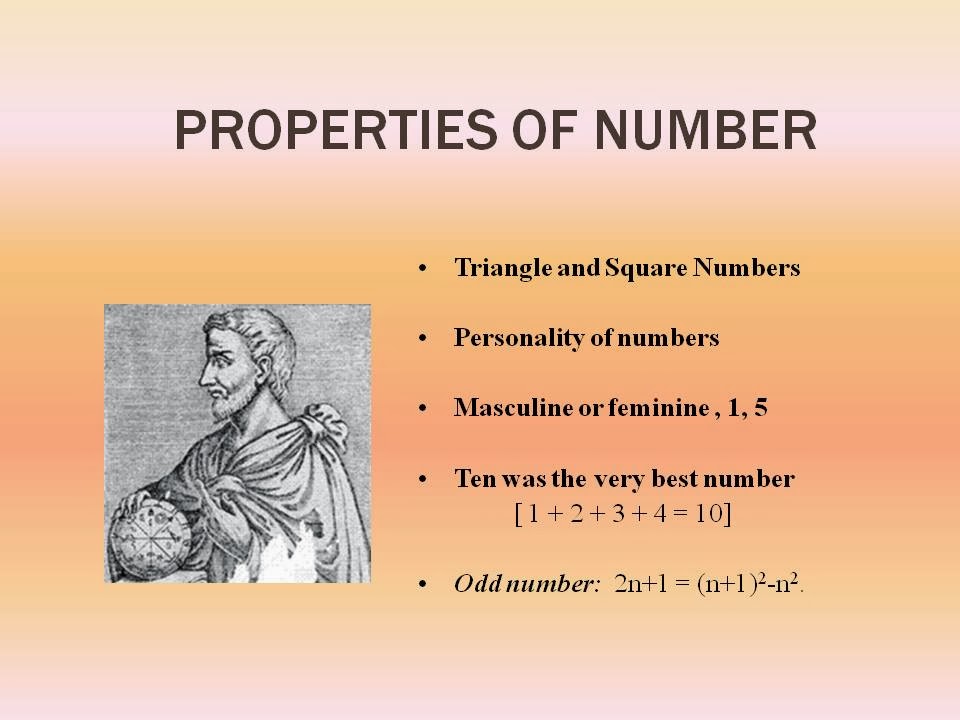
Ø    Triangle and Square Numbers: Pythagoras studied properties of numbers, which would be familiar to mathematicians such as today, even, and odd numbers, triangular numbers etc. However to Pythagoras numbers had personalities, which we hardly recognize as mathematics today.
Triangle Numbers
*
*
**
*
**
***
*
**
***
****
*
**
***
****
*****
1
1+2=3
1+2+3=6
1+2+3+4=10
1+2+3+4+5=15
Square Numbers
*
**
**
***
***
***
****
****
****
****
*****
*****
*****
*****
*****
1
4
9
16
25
Ø    Personality of numbers: Each numbers had its own personality – masculine or feminine, perfect or incomplete, beautiful or ugly. This felling modern mathematics has deliberately eliminated, but we still find overtones of it in fiction and poetry.
Ø    Masculine or feminine: His followers said that odd number was masculine gender and even number was feminine gender. The number 1 was a mother of all numbers. The number 5 was the symbol of marriage ceremony.
Ø    Ten was the very best number: it contained in itself the first four integers one, two, three, and four [ 1 + 2 + 3 + 4 = 10] and these written in dot notation formed a perfect triangle.
Ø    Odd number: He discovered that any odd number (say 2n+1) can be expressed as the difference of two squares: 2n+1 = (n+1)2-n2.


THEOREMS OF PYTHAGORAS:
The list of theorem attributed to Pythagoras, or rather more generally to the Pythagoreans are:
Ø    Properties of Triangle: The sum of the angles of a triangle is equal to two right angles.
Ø    Polygon Angles: Also the Pythagoras knew the generalization, which states that a polygon with n sides has sum of interior angles 2n-4 right angles and sum of exterior angles equal to four right angles.
Ø    Pythagoras theorem– for a right-angled triangle the square on the hypotenuse is equal to the sum of the squares on the other two sides. We should note here that to Pythagoras the square on the hypotenuse would certainly not be thought of as a number multiplied by itself, but rather as a geometrical squares is equal to a third square meant that the two squares could be cut up and reassembled to form a square identical to the third square. AB2+BC2=AC2
MUSIC
Ø     Pythagoras believed that all relations could be reduced to number relations. Pythagoras noticed that vibrating strings produce harmonious tones when the ratios of the strings are whole numbers, and that theses ratio could be extended to other instruments. In facts Pythagoras made remarkable contribution to the mathematical theory of music.
Ø     Pythagoras made useful investigations into music and began the theory of music by measuring the cords of the Lyre, a musical instrument.
Ø     Pythagorean Tuning : how the relationship between musical notes can be expressed in mathematical equations
GEOMETRY
Ø    Constructing figures of a given area and geometrical algebra-for example they solved equations such as a (a-x)=x2 by geometrical means.
Ø    The five regular solids: It is thought that Pythagoras himself knew how to construct the first three but it is unlikely that he would have known how to construct the other two.
Ø    He construct a polygons equivalent to one given polygon and similar to another and could construct the five regular polyhedron
Ø    Mensuration: Pythagoras studied the properties of area and volumes and he was the first to prove that the circle contains a greater area than any plane figure with the same perimeter while the sphere contains a greater volume than any other shape bounded by the same surface.
Ø    In solid geometry, Pythagoras called sphere the most perfect of all solids. He knew that were five regular solids which lie exactly in a sphere namely tetrahedron, hexahedron, octahedron, dodecahedron and icosahedron.
Ø    Many mathematical terms like parabola, lying side-by-side ellipse etc. can be attributed to Pythagoras.
Ø    The discovery of irrationals: this is certainly attributed to the Pythagoras but it does seem unlikely to have been due to Pythagoras himself.


ASTRONOMY
Ø    In astronomy Pythagoras taught that the Earth was a sphere at the center of the Universe. He also recognized that the orbit of the moon was inclined to the equator of the earth and he was one of the first to realize that Venus as an evening star was the same planet as Venus as a morning star.


MODULE 4 - SRINIVASA RAMANUJAN (1887 AD - 1920 AD)


SRINIVASA RAMANUJAN (1887 AD - 1920 AD)


Born
22nd December 1887 AD (1707-04-15)
 
Died
1920 AD
Residence
Erode , Kumbakonam
Nationality
Indian
Fields
Mathematics, Astronomy
Institutions
Cambridge university, madras university
Friend
Hardy

Srinivasa Ramanujan, one of India’s greatest mathematical geniuses, was born in his grandmother’s house in Erode, a small village about 400 km southwest of Madras, on 22nd December 1887. His father worked in kumbakonam as a clerk in a cloth merchant’s shop. In 1917 he was hospitalized, his doctors fearing for his life. By late 1918 his health had improved; he returned to India in 1919. But his health failed again, and he died the next year.
Ø  Five years old – primary school
Ø  Jan 1898 – town high school in Kumbakonam
Ø  1904 – he got scholarship
Ø  1906 – he entered in to Pachaiyappa’s college
Ø  14th July 1909 – he married ten year old girl S.Janaki Ammal
Ø  1911 – His first paper published, 17 page works on Bernoulli numbers - journal of the Indian Mathematical Society.
Ø  Ramanujan was appointed to the post of clerk and began his duties on 1st March 1912.
Ø  1914 – he went England
Ø  1916 – Cambridge university granted him a bachelor of science degree
Ø  1919 – he returned India


Contributions
·             Ramanujam made substantial contributions to the analytical theory of numbers and    worked on elliptic functions, continued fractions and infinite 1900 he began to work on his own on mathematics summing geometric and arithmetic series.
·             He worked on divergent series. He sent 120 theorems on imply divisibility properties of the partition function.
·             He gave a meaning to eulerian second integral for all values of n (negative, positive and fractional). He proved that the integral of xn-1 e-7 = ¡   (gamma) is true for all values of gamma.
·             Goldbach’s conjecture: Goldbach’s conjecture is one of the important illustrations of ramanujan contribution towards the proof of the conjecture. The statement is every even integer greater that two is the sum of two primes, that is, 6=3+3 : Ramanujan and his associates had shown that every large integer could be written as the sum of at most four (Example: 43=2+5+17+19).
·        Partition of whole numbers: Partition of whole numbers is another similar problem that captured ramanujan attention. Subsequently ramanujan developed a formula for the partition of any number, which can be made to yield the required result by a series of successive approximation. Example 3=3+0=1+2=1+1+1;
·             Numbers: Ramanujan studied the highly composite numbers also which are recognized as the opposite of prime numbers. He studies their structure, distribution and special forms.
·             Fermat Theorem: He also did considerable work on the unresolved Fermat theorem, which states that a prime number of the form 4m+1 is the sum of two squares.
·             Ramanujan number: 1729 is a famous ramanujan number. It is the smaller number which can be expressed as the sum of two cubes in two different ways- 1729 = 13 + 123 = 93 + 103
·             Cubic Equations and Quadratic Equation: Ramanujam was shown how to solve cubic equations in 1902 and he went on to find his own method to solve the quadratic. The following year, not knowing that the quintic could not be solved by radicals, he tried (and of course failed) to solve the quintic.
·             Euler’s constant : By 1904 Ramanujam had began to undertake deep research. He investigated the series (1/n) and calculated Euler’s constant to 15 decimal places.
·             Hypo geometric series: He worked hypo geometric series, and investigated relations between integrals and series. He was to discover later that he had been studying elliptic functions. Ramanujan’s own works on partial sums and products of hyper-geometric series have led to major development in the topic.


·             Journal of the Indian mathematical society: Ramanujan continued to develop his mathematical ideas and began to pose problems and solve problems in the journal of the Indian mathematical society. He developed relations between elliptic modular equations in 1910.
·             Bernoulli numbers: He published a brilliant research paper on Bernoulli numbers in 1911 in the journal of the Indian mathematical society and gained recognition for his work. Despite his lack of a university education, he was becoming well known in the madras area as a mathematical genius. He began to study the Bernoulli numbers, although this was entirely his own independent discovery.
·             Ramanujan worked out the Riemann series, the elliptic integrals hyper geometric series and functions equations of the zeta functions on the other hand he had only a vague idea of what constitutes a mathematical proof. Despite many brilliant results, some of his theorems on prime numbers were completely wrong.
·             Ramanujan independently discovered results of gauss, Kummar and others on hyper-geometric series.
·             Perhaps has most famous work was on the number p(n) for small numbers n, and ramaujan used this numerical data to conjecture some remarkable properties some of which he proved using elliptic functions. others were only proved after Ramanujan’s death.  In a joint paper with hardly, ramanujan gave an asymptotic formulas for p(n). It had the remarkable property that it appeared to give the correct value of p(n), and this was later proved by Rademacher.
·             Ramanujan discovered a number of remarkable identities that imply divisibility properties of the partition function. He also produced quite a number of results in definite integrals in the form of general formulate.
            
           Besides his published work, ramanujan left behind several notebooks filled    with theorems that mathematicians have continued to study. The English    Mathematician G.N Watson, from 1918 to 1951, published 14 papers under the general title theorems stated by Ramanujan and in all he published nearly 30 papers which were inspired by ramanjan work. In 1997 ramanujan journal was launched to publish work in areas mathematics influenced by Ramanujan”.